
TDC Me

Your Say

Together we can achieve more

  • Home
  • Inclusive Council
  • Environment
  • Water
  • Housing
  • Business
  • Transport
  • Dam
  • Contact
  • About
    • Testimonials

Lies Damned Lies and Statistics

14/08/2017

waimea plains picture

Following the distribution of the Newsline – the dam special edition, I have fielded a number of communications questioning the level of “propaganda” that council has stooped to. Initially, I was somewhat surprised of the response as my copy had not been delivered.  Interestingly, councillors had been receiving a pre release copy of Newsline for proof reading. This copy was not circulated prior to publication, so I did not have an opportunity to address the errors before it went public. Given that my opportunity to address issues privately was not given I will address my issues in the open forum.

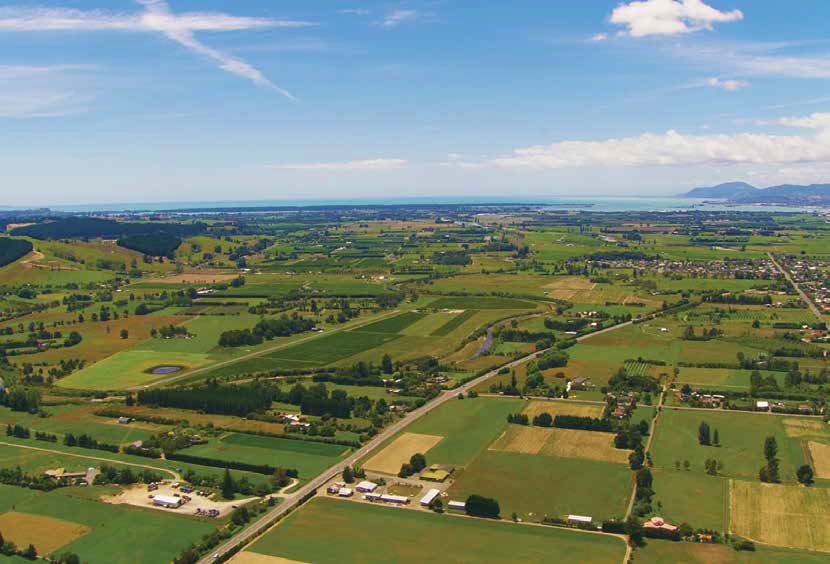
Without getting bogged down in the fine print, I will just address the glaringly obvious propaganda as presented pictorially. The first obvious use of “Lies, Damned Lies and Statistics” (as penned by an author of disputed origin) is found in the picture on the front page.
waimea plains picture
One wonders why a discussion about the Waimea Plains, as affected by the Waimea Community Dam, shows a picture of the Wai-iti Plains – not affected by the Waimea Community Dam?

Yes, it is possible to see the Waimea plains in the distance, but a good half of the land pictured shows land that comes under the 88 Valley (or commonly referred to as the Kainui) water scheme and is not affected by the Waimea Community Dam discussion.

The use of the picture really just highlights how little land mass we are really talking about when we hear the stories of great woe that befall the world food supply (as present to council by John Palmer) or the national food supply (as reported in Newsline).  Yes, there may be some impact locally to vegetable prices until another source is found in a no dam scenario, but a dire impact globally? Interestingly, the boutique crop of hops as mention in Newsline are mostly grown outside the Waimea Community Dam catchment – which makes one wonder if John Palmer is writing Newsline now.

Moving on we come to the pictures following the Mayor’s soliloquy.weight loss before and after

Sorry, these are not the dam pictures they are pictures of Bailey – winner of the 90 day weight-loss challenge at lifetime-weightloss.com.  And while I congratulate Bailey on her efforts, I find the photos used here typical of photos used in this genre of advertising.

And I am sure that many of  you will have noticed that in advertising the benefits of the Waimea Community Dam  that we have used the same template as the traditional weight loss miracle cure before and after photos.Waimea River With Dam

With a dam we use the flash on, bright colours, full make-up, hair fresh from the salon, and big smile template.  It is a sunny day, we have chosen a cross-section of the river where there is lots of green grass in the picture, and the fish are playing happily (we can assume).

No dam no sun pictureWithout a dam the story is much different. There is no smile, no make-up, no flash photography, and the hair is messy.  Or at least the picture has been photo-shopped to appear devoid of 90% of the colour. Ironic really given that the water crisis generally occurs mid summer. We have also chosen a different cross-section of the river that contains no greenery, only grey lifeless gravel, and one can only imagine in this Armageddon-like scene that the fish are not smiling at all.

The reality is that had both pictures been taken from the same perspective on equally sunny days you would barely see a difference between an 1100 litre per second flow an 800 litre per second flow.

Of course that is not the only occurrence of where we have refused to let the facts get in the way of a good story.

average water use for common tasks chart

“Average” in a mathematical sense usually refers to a mean average or a median average figure. Median being a mid point figure, and mean referring to number generated when the sum of figures is divided by the number of figures used.

In this list of common water usage activities the term Average would appear to mean something entirely different – I am not sure what. Take for instance the average figure given for flushing the toilet, here it is given as 11 litres. While old single flush toilets may have used 11 litres per flush or more, the Caroma national survey reveals 60% of households use a split flush system, most of which operate on a 6/3 litre flush and newer design toilets are even more economical again with their water use. So, for the “average” flush to be 11 litres some people must be using their bath as a header tank to flush the toilet.

The same can also be applied to the 5 litre figure given for hand washing. That is two and a half ice-cream containers of water used for every hand wash. Some people must have a lot higher water pressure than me, or they take an extra ordinarily long time to wash their hands, or again, they are filling the bath to wash their hands if the “average” figure is 5 litres per hand wash.

The next chart that I would highlight is exactly the kind of use of statistics that the author of the “lies, damned lies, and statistics” quote would have been referring to, I am sure. Augmentation option statistics
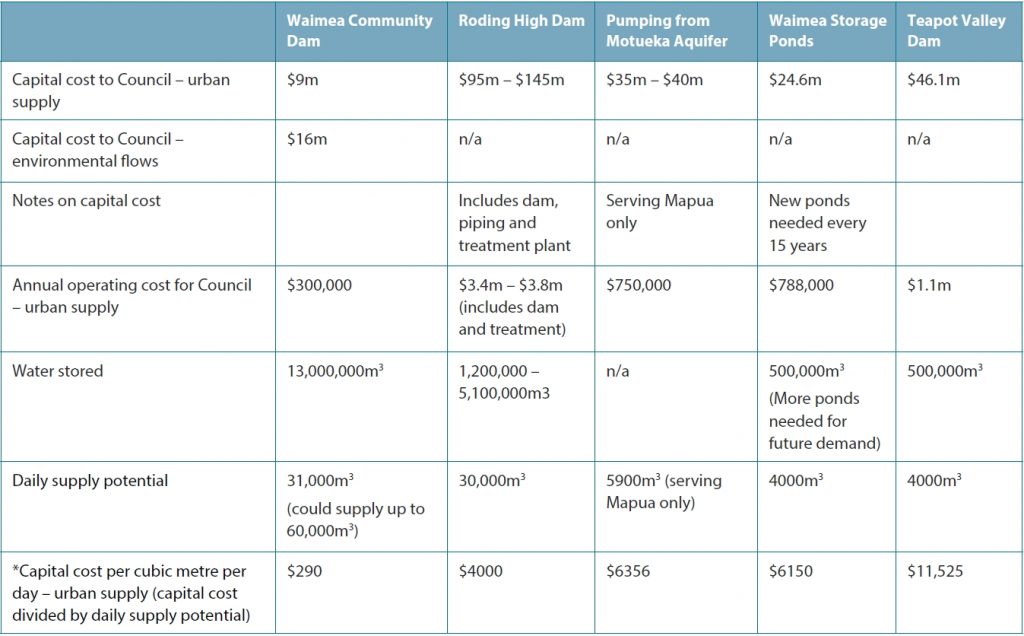
Council staff will apparently tell you that this accurately represents the associated costs of the dam to urban water users.

The first fallacy is that it assumes that urban supply users are not general ratepayers as well because there is no ongoing costs for “environmental flow” included in the graphic – which is odd because they include the environmental flow component of construction costs. Even in this model urban supply users will be paying general rate subsidies of the actual cost of water supply from the Waimea Community Dam. I repeat, these figures are not shown on the table.

The other issue with this model is that “environmental flow” costs have been segregated out in the first place. When this model was first presented to council environmental flow was described a separate entity from water extraction. What has since come to light is that environmental flow is a direct cost of using the river as a conduit to run water from the augmentation source (the community dam) to the end user.

The reason that all the other options looked at are outrageously expensive by comparison to the Waimea Dam is because all the other options have to include piping from augmentation source to end user. We cannot use the river as a conduit to channel the water if we are putting in X litres of water at the top and taking the same X litres of water out at the bottom of the river (or where ever extraction occurs). To use the river in this manner would necessitate supplying a certain level of environmental flow above the water extraction levels which none of the other options have capacity for.

Not only is there a saving in piping by using the river as a conduit, there is also a large saving from treatment because the river is doing the bulk of the “treating” of the water for us when it is used as a conduit.

Therefore, the cost of using the river as a conduit (rather than piping and potentially treating) is that environmental flow has to be accommodated for.  This is not a “public benefit” cost that should be attributed to the general rate payer, this is a water extractor cost that is currently being directly subsidised by the general rate payer. Another means by which the general rate payer is being expected to prop up the billion dollar industry generated from irrigation on the Waimea Plains.

Finally, I would question the doughnut chart that depicts financial contributors to the dam.break down of dam financial contributions

Little details like the “SPENT” portion is added on the opposite side to the council contribution could raise eyebrows. I am wondering what genie contributed these spent funds.  At this rate the dam will be built using “spent funds” and council will announce that we have saved the rate payer $25 million by not using the allocated budget from the Long Term Plan, even if it costs council $50 million in spent funds.

But, I guess that is how we can keep council contribution to the quoted 33% if we don’t include spent funds, which looks like a really good bargain.

There is also the small matter of CIL contributions included as the same colour as Waimea Irrigators $15 million contribution. In my business education I understood that the person who underwrites a loan is the person responsible for the loan (many a parent, and best friend, has come unstuck by not fully appreciating this fact). Given that council is being asked to underwrite the CIL loan it could be considered misleading at best, and down right deceptive at worst, to attribute that loan directly as WIL contributions.

If the Waimea Community Dam is the goose that lays the golden eggs:

as the proponents of the dam would have us believe, then why is it consistently being over-sold?

The most damage to the dam progress has not been fliers delivered by Murray Dawson or other anonymous detractors. The most damage to dam goodwill among the general rate payers is the constant and consistent propaganda put out by the Council and Waimea Irrigators.

Why are we using suspect at best statistics, and outright lies to sell what is reputedly a no-brainer for the Tasman District?

Yes, I said outright lies. If you consider that none of the above are lies, then panic not. I have other examples where I have been directly lied to in relation to questions I have raised, and information that has been presented to me as a councillor with regard to the Waimea Community Dam. Examples that will have to wait for another post as this post is supposed to be a quick analysis of some of the obvious propaganda presented in the Newsline special edition.

We could have looked at some of the anomalies in the small print but given that the recipients of Newsline are obviously deemed to be imbeciles by the authors of Newsline one would assume that the recipients don’t read the articles.

Perhaps the Waimea Community Dam is actually a lemon painted up to look like a Ferrari?

Perhaps we should accept the offer ( or threat, depending on how you read the articles) of the Waimea Irrigators who have publicly stated they will pack up and move on if the dam is not built?  That would solve the over allocation of water situation amongst the irrigators and those that remain will then have a greater security of supply.

It is hard to see the best solution amidst all the smoke and mirrors and statistics spewing forth from the irrigator/council marketing department.

Filed Under: Projects, Spending, Your Say Tagged With: TDC propaganda, Waimea Community Dam, Waimea Dam lies

Memoirs of a rubber-stamping monkey with the memory of a goldfish

22/07/2017

Rubber Stamping Council Style

The mistake I made when I was sworn in as Tasman District Councillor is that I took my position too seriously. It turns out that I am paid peanuts because I am expected to be a rubber-stamping monkey with the memory of a goldfish.

I came to this conclusion after numerous discussions around the council table and in private with people whose pay grade far out-ranks my own.  I have been told that I am just uninformed as a new councillor, and that is why I should vote the way of the good-old-boys. I am told I am acting irresponsibly for not rubber-stamping the proposals put before me.

Rubber Stamping Council Style
Signed … Monkey.

It gets worse. I have been told on the issue of the damn dam that even if the current dam proposal isn’t the best option at our disposal, although it obviously is, but even if it isn’t that we have no alternative other than to build it because we simply don’t have time to implement another option. On top of that I am told that I may have to ignore the voice of the majority of rate-payers if that is what it takes to get the job done. In other words, “Just rubber-stamp here.”

When I pointed out the problem I had with the inconsistencies I was being presented with to one highly paid individual I was told I just “need to get over it.”

So, you see, I am now at the point where I can see the error of my ways. I was thinking my role as an elected member of council was somehow important. Inflated impression of self-worth aside, I just over estimated the role of a councillor. Had I read the job description instead of just the lunch menu I am sure I would have read applicant must be a rubber-stamping monkey who cannot remember what was said in the last paper stamped because it will probably contradict what is in the paper you are currently being asked to stamp your approval on.

Now that both my pay grade, and my level of responsibility, have been established I am sure that I am going to be a far more effective in my newly informed role. I certainly won’t be taking myself, or my votes, too seriously moving forward.

Signed …. Monkey

Wait what did I sign?

Filed Under: Projects, Spending, Your Say Tagged With: councillor, rubber-stamp, tdc, Waimea dam

Mayor Votes Rate Hike For Dam

15/06/2017

waimea dam

Mayor Kempthorne goes it alone and agrees to invest an extra $3 million in the Waimea dam project and to underwrite $25 million dollars of irrigator loan. Well, he voted alone using his Mayoral privilege to cast an extra vote in a hung council verdict, but the money comes from general ratepayers.

gold plated dam

A robust debate around the table followed a number of public speakers having their say on the dam.  The options presented to councillors were to vote for more money to take to the negotiation table or to walk away from the negotiation table causing the collapse of the project in negligence of our duty.

Councillor Wensley tried to present another motion where council remained at the negotiation table with the mandate to hold to council’s position as presented in the long-term plan 2015-2025. This was unable to be voted on without the failure of the tabled motion. A chance the Mayor scuttled.

Questions raised by this decision include:

  • Why is council around the negotiation table at the 11th hour trying to establish a business model for the dam?  It would have seemed to me to be good practice to have established Governance and funding responsibilities before spending millions of dollars of ratepayer money.
  • Now that council has over-committed itself in the business model negotiation phase of the dam, and the irrigators have been bled dry, who is going to pick up the tab for any inflation in quote price or construction over-runs?
  • Is there any point in this process where those pushing the dam would consider it too expensive as beneficial as it may be?

Ironically the last time council was deadlocked over a decision it was to do with setting the rates for the current year.  A number of councillors wanted a modest 1.5% percent rate increase this year to help pay down our mountain of debt. The Mayor and many of the others who voted for the extra dam spend said we had to hold the rates at the 0.6% because there are residents in the Tasman district who cannot afford to pay their rates, and Tasman is near the top of the rating table amongst our peer councils.

I asked where these poor people had gone, as over the next five years council will be struggling to maintain rate rises below the 3% cap — a total of 15% in five year’s time (actually 16% if you take the cumulative content into account). This is without any further overruns and assumes council has the ability to maintain the 3% cap.  I was not given an answer.

Those of us who voted against the motion were not voting against the dam. We were voting against the increasing of the council’s commitment over and above the increase that a percentage share would involve as per the business model presented to us when the current council was established.

The chance to vote yes or no on the dam is yet to come following a public consult. Theoretically, we will have more facts around the build cost of the dam, the level of contributions that all parties will be investing, and perhaps the cost of a viable plan B (however, inferior in benefit delivery).

I believe that all the facts should be on the table in order to make a fully informed decision. Inflated positions to persuade a decision one way or the other help no-one. If I am going to be held accountable for my decision (as I would expect to be) then it needs to be based on a lot more facts than have currently been tabled.


Filed Under: Projects, Resources, Spending Tagged With: casting vote, Mayor decides, more dam money, Waimea dam

Council Priorities

16/05/2017

TDC stormwater problems a matter of priority

In a recent council meeting, Councilor Ogilvie highlighted the problems working within the council system that we have.  Cr Ogilvie moved a motion to bring forward a Motueka Storm Water project.

While this is a problem that needs addressing and is causing considerable distress to the residents in Motueka affected by repeated flood occurrences, the project was placed in a work stream set by the previous council to occur in the 2018 year. These were the same councillors who Cr Ogilvie suggest would today be thumping the table and shouting to just get it done!

Cr Ogilvie also suggested that it should be brought forward because there was money in the stormwater budget that had not been spent. What the councillor didn’t mention was that one of the reasons our capital works budget has not been entirely spent is because we do not have enough staff to manage all the projects currently planned. Another reason is that we are currently struggling to get contractors to bid on projects because of the high demand for earthworks post the Christchurch and Kaikoura earthquakes.

In this environment, it is not only impractical, it will also come with considerable extra expense to disrupt the planned workstream to bring projects forward and other projects in. Of course, Cr Ogilvie believes that council debt is too low and would happily run it up so that side of the equation doesn’t concern him but he also believes that bringing projects forward will not be at the detriment of other already planned projects – despite staff indication that this is not the case.

This scenario is why it is extremely important to set priorities as the council considers its long-term plan.  Sports and recreation are nice to have, but should council be spending large amounts in this area when people are constantly being flooded or have substandard water supplies? I don’t believe so.  This is why in a recent council workshop I voted against spending $60k plus on a feasibility study for a Wakefield/Brightwater community facility. Not because I don’t think our community would benefit, but because I think we have more pressing issues to attend to first and especially because the building of said facility was signalled as at least 10 years out. I was the lone voice of prudence in that workshop among councillors present.

If we are going to keep debt under control the only way we can achieve affordable rates is by prioritising spending. The Government has an increasing number of initiatives that it inflicts upon Councils which limit our spending options in order to meet these requirements, so our discretionary budget is reducing every year. This makes it increasingly important that staff numbers do not spiral out of control (although every Government initiative requires more staff hours to comply) and essential infrastructure needs to be prioritised over amenities.TDC stormwater problems a matter of priority

It is no good changing your mind and thumping the table after budgets have been allocated and workstreams set in place about priorities you now think are more important – that is not the system we work with, whatever its flaws may or may not be. I hope we see a more rational approach to the next long-term budget although early indications would suggest not.

Yes, stormwater solutions should be a priority – but a planned and budget priority, not a lolly scramble priority decided by who shouts the loudest at the next council meeting. 


Filed Under: Projects, Spending Tagged With: council priorities, Debt, stormwater

Wakefield Express Bus Service

03/04/2017

wakefield express bus trial

There is a lot of talk about the Wakefield Express Bus service trial that has been requested by some members of the community.  The general view within council is that a study should be conducted into the feasibility of such a service as the correct path with which to proceed, a prudent approach given the economic inviability of such services in the past due to lack of support.  The typical Facebook kneejerk reaction is that a trial will provide the evidence for a feasibility study.  The likely result of an uninformed trial is that it will meet with failure and the bus service will then be unlikely to eventuate in the next 25 years.

Nelsust, who are actively trying to block the Southern Link roadway into Nelson, presented reputably a thousand signature petition to council in support of the bus service. Disregarding the several pages of graffiti tucked away in the middle (oddly reproduced numerous times for all the councillors from a group advocating sustainability), the petition for an express bus service between Wakefield and Nelson was well supported from as far afield as the Gold Coast, Tasmania, Christchurch, Monaco, and Cable Bay. Even within our region it garnered support from Murchison, St Arnaud, Korere, Tadmor, Belgrove, Moutere, Redwood Valley, Mapua, and a surprising number from Stoke, Tahuna, and Nelson.

The petition also included requests for the Wakefield express bus service to start at 88 Valley, to make more stops in Hope, to “Make it go past Waimea Village,” serve “Batup road to Richmond” and to provide “An on request stop at Nelson Airport.” It should service school children travelling into Nelson, practicing sport/cultural events after school, and it should also “Cater for older people that wish to spend 3 or 4 hours in Nelson.”

As for the times that we expect the Wakefield express bus service to operate, according to the survey, here is a sample:
“6.45 am – 10pm”wakefield express bus trial
“7am – 6pm”
“8am – 6pm”
“8.30am – 2.30pm”
“8.30am – 5pm”
“8.45am – 5.45pm”
“9amish -2.30pm”
“9am – 5pm”
“10am – 4pm”
“10am – 5pm”
“11am – 10.30pm”
Suggesting a bus every 15 minutes should about cover it, but only operating 7 days a week.

Apart from the obvious conflict of what exactly is the peak commuter service, there is also the conflict of wanting an express service and a service that caters to the rest of society. Petitioners, both in the survey and in the council public forum, suggested that the elderly need an alternative to taxis or reliance on other people. Having been a taxi driver, I do not see a one stop service in Richmond aiding the elderly who wish to travel to the doctors or grocery stores being of much benefit, especially when the time between buses is likely to be 8 hours or more.

The suggested route includes Whakatu Drive and using Beatson road (sorry Stoke, Tahuna, and airport signees), which I find fascinating given that Nelsust do not want the Southern Link to run through there. A bus service running all day every day through there is acceptable but not for anyone else. Remembering that Nelsust is also the group that was going to solve the traffic congestion on Rocks Road by storing logs on Rabbit Island instead of at the port. Despite the fact that they had no idea of how the barging would be achieved, they also failed to take into account that half the logs arriving at the port come from North of Nelson so they would be trucking them via Rocks Road instead of the Southern logs.

Now Nelsust would have the ratepayers of Tasman funding a Wakefield express bus service trial without conducting a feasibility study into the best times, best route, and coming up with a pricing structure that may work.  I was going to suggest that the people of Murchison, Takaka, Motueka, and surrounds might not be too keen on subsidising the few that might use such a service, but according to the petition, the service is widely supported from outlying regions.

Even from the comments on the survey that was submitted there is an underlying reason that many people support the service. Comments such as “Would free up carparks for those that genuinely need them,”  “More cars off the road at peak times,” and  “It is unlikely I will ever use such a service but the whole region stands to benefit” indicate that many people want the bus service for other people to use so that they can travel and park much easier while travelling in their own vehicle.

Which brings me to my next point. Nelsust state that “Each bus can keep 40-50 cars off the road: This is about a km of loadspace saved and is part of the jigsaw of actually reaching road congestion at peak times that we know roadbuilding doesn’t solve.” This one of the main thrust of those presenting the petition to council, that each bus would remove up to 50 cars off the road. This tells me that the current culture is as represented by this comment: “I would fully endorse a bus service as described above, I currently drive alone to Nelson.”

Most of the vehicles travelling in commuter traffic have one occupant or two at best. So, I disagree with Nelsust and this petitioner who believes that “…we need to reduce the volume of personal vehicle movements. Nelson and Tasman councils need to be proactive guiding and supporting this change, and funding public transport is highly likely to be the cheapest and simplest lever to pull in this regard.”

The simplest and most cost-effective lever to pull to prove that public transport is a viable option is car-pooling. This is a no cost to the rate-payer risk-free alternative to a bus trial that will prove that people are of a mind to share transport, and that is through organising car-pools. This can be done very easily through social networks, online networks, phone apps, and local news advertising.

I would be more impressed and more likely to endorse council funding a bus trial had Nelsust come to us with a proposal to take 6 – 10 cars off the road, rather than the 50 they currently suggest for each bus. A list of car-pools operating at the time of a suggested bus route would carry a lot more weight than a petition carrying 1000 signature from here to Australia as it would show demand for shared transport and pattern of behaviour already established.

Nelsust believe that the point of difference of a bus is:

1)      that bus passengers can get things done on the way, whether texting,
phoning, reading, knitting or talking to strangers, whereas in a car the
commute is a waste of time,

2)      that anyone with a conscience about carbon emissions can travel guilt
free, as the bus is going anyway,

3)      for people who have to rely on parents or others to drive them, the
point of difference is independence.

Carpooling also allows the majority of travellers to knit, text, phone, read, or talk to strangers. If we do not get the bus service matched to the needs of those who will actually use such a service then the buses will be running empty in addition to all the other carbon emitting vehicles on the road. And for people who have to rely on others to drive them – they will still be relying on others to drive them (duh!) it is just that all the other rate payers will be expected to fund their transport.

It is also a valuable note for those presenting petitions to the council to have their facts in order before coming and telling us about things that they apparently have no knowledge about. It does not help your cause when you stand there and tell us replacing all these light vehicle movements with heavy vehicle movements will save on wear and tear of the roads – when the converse is actually the case.

To summarize, Nelsust want council to just go ahead and put on an express bus service between Wakefield and Nelson running at “peak hours only” with “intermediate stops at Brightwater and Richmond” (without giving us any indication of what peak hours are, or how many intermediate stops) to cater to commuters, the elderly, and for school children. As was commented by another member of the public when the petition was presented, in order to contribute to the success of the trial council would also be expected to erect bus shelters at the various stops.

And they want us to “just do it” (to quote Nike), the most probable response will be to quote a local beer commercial …

Filed Under: Projects, Spending Tagged With: commuter bus, Tasman bus service, wakefield express bus

« Previous Page
Next Page »

Introducing Dean

Dean McNamara Husband, father, and a fourth generation local from rural Tasman. No longer acting as your voice on the Tasman District Council (TDC). More about me.

Email Newsletter

Sign up to be informed of important news and upcoming events

Make your voice count

Testimonials

Fantastic Speech

It was great to have your involvement in the dawn blessing of the Mapua Sculpture at the beginning of March. Thank you for the fantastic speech which encapsulated the essence of what the Sculpture Project is all about.

Janet Taylor
Ruby Coast Initiative Trust

You Rock

[Thankyou] for standing up for democracy & the people you represent. In the words of a younger generation “You Rock”!

Beth McCarthy
Takaka

keep sticking it to them

What a great pity there aren’t more councilors like yourself, who stand for council on behalf of the voters, and who remain steadfast in their commitment to being voter representatives and not council mouthpieces

Gary Thorpe
Read more testimonials
  • Testimonial Submission Form

Councillor McNamara: As Reported In The News

  • Latest News
    • Yet Another Unbudgeted Spend
    • Dam Tax Bites Little Guys
    • Freedom Camping Waste
    • No Support For Dam Report
    • Developing Within Boxes
    • Grandstand Funding Folly
    • Population Projections
    • Recycling Lunacy
    • Another Dam Blow Out
    • Councillors Not Qualified Directors
    • Mapua Boat Ramp
    • Pokies Sinking Lid Policy
    • No More Mayoral Casting Vote
    • Votes By Ward
    • Returning as Councillor
  • News From Last Term
    • Signing Off
    • Waste (of) money
    • Port Tarakohe
    • Free Charging Not Free
    • Re Election Candidates
    • NZTA Priorities
    • Mapua Upgrade Begins
    • Another vote Uturn
    • Traffic Woes Government Nos
    • Consult Fairy Tales
    • Capital Stop-Works
    • Kempthorne Quits
    • 20 million not a significant change
    • Over paid Councillor
    • Dam Train Wreck
    • Death Vote For Dam
    • Dam Scarce Water
    • Barbershop Gossip
    • Dam budget blowout
    • Dam Secrets
    • Wakefield Water Supply
    • Kempthorne Casting Votes
    • Mapua Gateway Sculpture
    • Mayor Spends Up Again
    • Mayor has a talk
    • Alleged Propaganda
    • Dam Affodability Questioned
    • Dam Funding Questions
    • Dam Questions
    • Storm Water Priorities
    • Knitting up a storm
    • Old guard take on new committee roles at Tasman District Council

Archives

Share the joy

Why Vote McNamara?

I am MOTIVATED.
I have business EXPERIENCE.
I am fiscally FRUGAL (some say tight!).
I am a born and bred LOCAL - here to stay
I am CONTACTABLE - reach me through this website.
I know together WE CAN DO BETTER.

Tags

3 waters Campground casting vote cost of the dam council councillor role dam overruns Dean McNamara Debt decisions Dr Mike Joy Easter Trading Election fine print free lunch Funding inconsistencies lie Lies Mandates McKee Memorial Reserve performance Pigeon Valley Fire rate affordability Rate increase rates Richmond risks rules Shane Jones spending stormwater strategic misrepresentation Tasman Tasman council elections Tasman District Council tdc TDC propaganda vote Waimea Community Dam Waimea dam waimea irrigators water water bylaw WIL

Copyright © 2026 · TDCME.nz · Powered by Nz Marketing Systems · Log in

This website is authorized by Dean McNamara 22a Edward Street Wakefield