Here is a sentence that should have made the front page of every newspaper in the Western world last month. It did not.
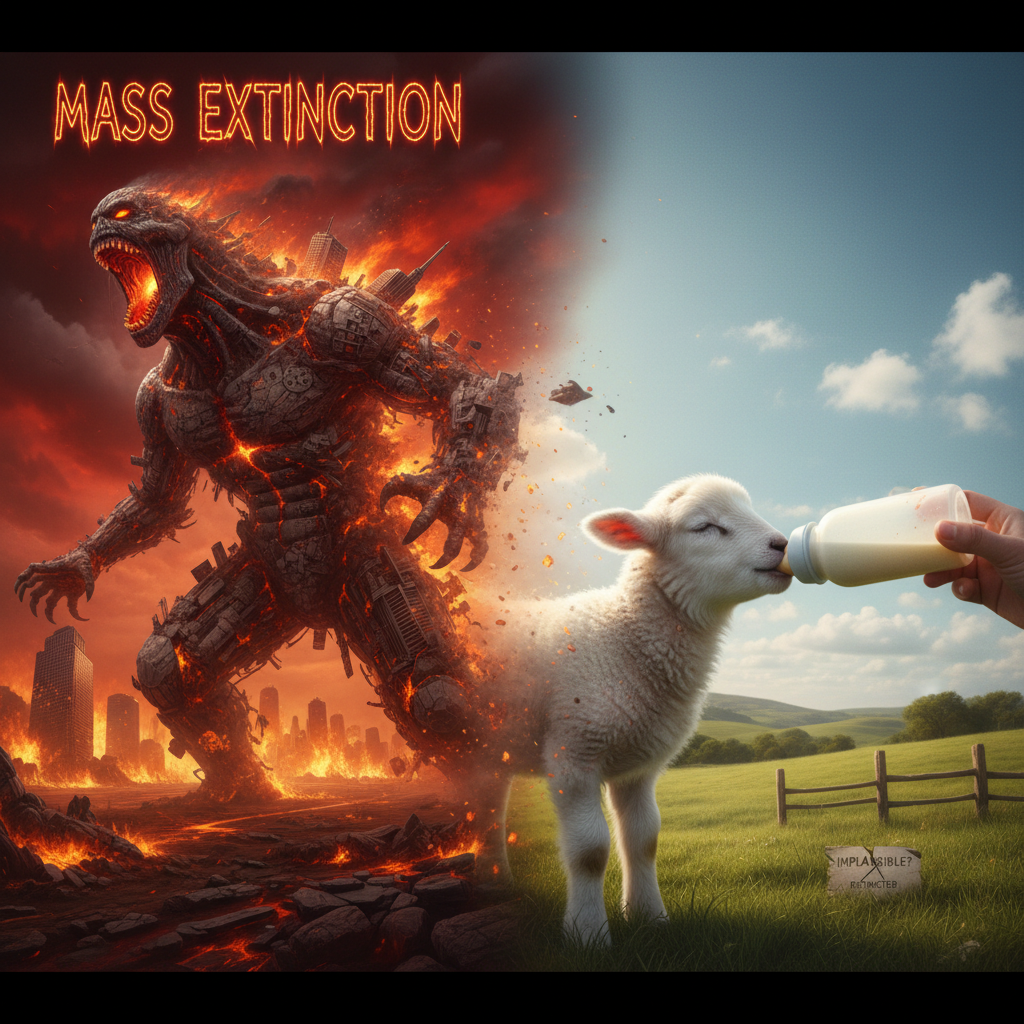
Scientists writing in the journal Geoscientific Model Development formally declared that the IPCC’s headline worst-case climate scenario — the one projecting 4 to 5 degrees of warming by 2100, the one that underpinned a generation of extinction predictions, net-zero urgency, and a significant portion of the economic restructuring of the developed world — is “implausible.”
Not revised. Not updated in light of new data. Implausible. Their word, not mine.
The scenario in question is called RCP8.5. If you have read anything about climate change in the last 15 years — and you have — you have been consuming its outputs. The melting glaciers, the crop failures, the catastrophic sea level rises, the species extinction modelling, the Davos briefings, the school strikes. All of it was anchored, to some degree, in a model that assumed coal consumption would increase roughly sixfold by 2100. A model that critics — actual scientists, not bloggers — have been calling implausible since at least 2019. A model that the World Economic Forum was still using as recently as 2020 to show audiences what “more than 4°C of warming” would do to the planet.
It is now officially dead. Euronews reported this morning that the new worst-case ceiling has been cut by a full degree Celsius.
Positive revision, apparently.
Now, Donald Trump. I am going to ask you to set aside whatever you feel about the man for the next two minutes, because the truth does not care about your feelings toward the messenger.
On Saturday he posted this on Truth Social:
“GOOD RIDDANCE! After 15 years of Dumocrats promising that ‘Climate Change’ is going to destroy the Planet, the United Nations TOP Climate Committee just admitted that its own projections (RCP8.5) were WRONG! WRONG! WRONG!”
He is not wrong. The spelling is creative, the caps lock is doing considerable work, and the political framing is nakedly self-serving. But the underlying claim — that the IPCC’s flagship doomsday scenario has been admitted to be wrong — is factually accurate. Unusually for him, he was also early. He has been saying this since before it became institutionally acceptable to say it.
The people now scrambling to contextualise the revision have landed on a story: we updated the models because renewables got cheaper and emissions are tracking below the worst-case. In other words, the policy worked. Science in motion. Nothing to see here.
This explanation deserves a little scrutiny. The RCP8.5 scenario was never described as a policy-failure scenario. It was described as “business as usual.” It was the baseline. What happens if we do nothing. Roger Pielke Jr., a climate scientist who votes Democrat and has been making this specific argument since 2019 — and who has been dismissed and attacked for making it — wrote this week that RCP8.5 is now officially dead. He has been right about this for years. He was not thanked for it.
The idea that the revision is a clean success story for climate policy requires you to believe that coal consumption was always on track to increase sixfold, and only heroic intervention stopped it. The alternative explanation — that the scenario was always a stress test dressed up as a projection, used to generate urgency that the actual science did not quite support — is not one you will find prominently featured in the coverage.
The science is settled, climate change is real and we are all going to die. Familiar positions taken from around the council table. It is costing you hundreds of thousands as a rate payer to fight the impending doom – that apparently isn’t.
Here in New Zealand, this matters. We restructured agricultural emissions policy around urgency derived in significant part from these projections. We told farmers they were going to cook the planet. We built an Emissions Trading Scheme, set methane targets, and began a legal and economic overhaul of the primary sector on a timeline calibrated to scenarios the IPCC has now formally walked back. Some of that policy may well have been worth doing regardless. But the urgency — the you-have-no-choice-and-no-time framing that shut down debate — was borrowed from models that were, to use the technical term, implausible.
It is worth asking who decided that was an acceptable way to run public policy. And it is worth asking what other assumptions, baked into the modelling that shaped a decade of New Zealand legislation, are similarly due for a quiet revision.
To be precise about what I am not saying: I am not saying climate change is not real, or that warming is not happening, or that doing nothing is a sensible policy. The IPCC still projects meaningful warming under its revised scenarios. The risks are real and the direction of travel is not good. What I am saying is that there is a meaningful difference between “we face a serious challenge that requires considered policy responses” and “we face extinction and anyone who questions the models is a denier.” The first is defensible. The second was never fully supported by the science, and the institutions responsible for the second owe the public a more honest accounting than a quietly updated journal paper.
Trump said “WRONG! WRONG! WRONG!” He is not the messenger anyone would have chosen. But on this occasion, he is pointing at something real.
The least the institutions involved could do is say so directly, in plain language, without the journal paywall.
- Read the Geoscientific Model Development paper here.
- Trump’s full statement via Climate Depot.
- WEF’s 2020 worst-case scenario briefing.
- Roger Pielke Jr. on RCP8.5 being officially dead.