TDC Me

Your Say

Together we can achieve more

  • Home
  • Inclusive Council
  • Environment
  • Water
  • Housing
  • Business
  • Transport
  • Dam
  • Contact
  • About
    • Testimonials

Tasman District Council Remains Economical – With The Truth

28/08/2018

Waimea Dam You Pay

This Council is always looking for ways to save. We have found that we can stockpile the truth by only using it sparingly.

For instance, in the agenda for Tuesday 28th August 2018 the council staff inform me:

Funding and Finance – Waimea Community Dam
The Nature of Public Investments

18.10 Concerns have been raised in the past about the Council’s investment in the proposed Waimea Dam being a subsidy to irrigators. What is proposed is not that but is an increased Council contribution to get a project over the line. The Council should be motivated to do that (within limits) because the do nothing and alternative augmentation options cost the community more and/or deliver less value.

18.11 Public capital investment in government-owned assets creates the opportunity for private investment and productivity – that is why councils and central governments do it. The effect of public capital investment on economic growth is hotly debated. While analysts debate the magnitude, the evidence is that there is a statistically significant positive relationship between infrastructure investment and economic performance.

18.12 In the case of this project the investment opportunities are for the irrigators and others to take. Some may argue that there is an element of exclusivity here in that ‘affiliation’ and a water supply agreement is required to gain access to the benefits. In other words, access is available for a fee.

18.13 Other public investments in assets such as roads, airports, ports, transit systems, and even community facilities create investment opportunities for and ‘subsidise’ someone. Our consenting and regulatory work enables developers and others to profit also. While some may be genuine public good and access is ‘free’ there are many other examples where a fee is needed to particulate.

It is such a relief to know that this dam funding model is not a subsidy to irrigators – I was obviously mistaken when I highlighted the ways that this project has gone from an extractor/user pays model to a huge subsidy of irrigators.

It turns out that the urban water user and general ratepayer (staff use the term “Council”) is making an increased contribution to get the project over the line. This increased contribution reduces the amount that the irrigators are paying for their shares, and increases the cost of our shares as the percentage of water allocation remains the same. Which is obviously a different model to the irrigators getting a subsidy.

Here was I thinking that a subsidy is not a matter of opinion, it is a matter of simple maths. Either you are paying the same rate as everyone else for your shares, or you are getting discounted shares at someone else’s expense (a subsidy by any other name).

It is interesting to note also that other public investments in assets “subsidise” someone. It appears if you use “air quotes” when talking about something, like a subsidy for instance, it is somehow not an actual subsidy but instead it is a “subsidy.” This clarification is important because once upon a time I would have said staff are lying but now I understand that they are just “lying” (which is not telling real lies, just the other kind of lies).

“Lying” appears to be a common trait amongst those ardent supporters of the dam. We have seen that irrigators are often found to be “lying,” such as Juliane Raine who also claimed there was not a subsidy of irrigators, and Murray King was picked up by Newsroom reporters as using truth in an economical fashion

King bristles at suggestions the extra irrigation might pollute the very waterways it’s trying to save. “This area is already heavily irrigated. And when people say that it’s going to lead to more nitrates and things it’s just not true.” (However, he adds the disingenuous line that “farmers are not in the business of wasting resources”, which, if true, would mean councils wouldn’t have to impose rules to fence off waterways or limit farm runoff.)

And again:

Another points-scoring argument comes from Waimea Irrigators’ King: “The more you delay the project, the more it costs.” But then he adds that delaying have often been “instigated by the naysayers”, when it appears the project’s biggest hurdle has been funding.

However, it is not just irrigators that stoop to using “lies” to get their point across with more conviction. Independent CWS Advisory Group (who are independently ardent advocates of the dam) representative Morgan Williams has offered to sell his reputation down the toilet for free (likely a candidate for a Tui advert I suspect). I am sure most Tasman residents heard the radio adverts and received a glossy flier in their letterbox paid for by ….  (good point, who is funding Mr independent Williams and friends?).

He claims that without a dam there will be serious water cuts, and the Waimea River will get sicker. Well, which is it Morgan? Is the river going to dry up or are we going to have water cuts?

The dam is the only option, using natural gravel “pipes” to feed the land and fill our urban water supply. Note the use of air quotes around “pipes” because they are not real pipes – in fact they are not pipes at all. The truth is that we are using the river, and urban water user and general ratepayer is “subsidising” (staff tell me it is not real) the irrigators use of the river “pipes” under some fictitious concept called environmental flow costs.

The “Who Pays? Donut chart would have you believe that the ratepayer is picking up hardly any of the bill. In running costs alone you are paying 51% (which is conservatively around $81,100,000, over 100 years) never mind actual contributions, and underwrites of irrigator loans etc.

There are many more economies of truth in the flier such as alternatives that won’t work, the dam is the most affordable option, the project has region wide benefit, etc etc. But I will highlight just one more.

Votes YES for the Waimea Dam

Morgan Williams, ardent supporter of all things truthful would have us believe that the Waimea Community Dam has had 18 years of YES votes at “every stage” of the Community Dam. Very conveniently, he entirely overlooks the 11th December 2014 vote that was a NOT YES, back when the Council consulted on a Council owned and funded dam.

Tasman District Council Minutes of Full Council – 11 December 2014 Minutes

That the Full Council

  1. receives the Proposed Waimea Community Dam – Funding and Governance Options report RCN14-12-01; and
  2. agrees not to include either option 1 or option 2 of the funding proposals from the Funding and Governance Statement of Proposal consulted on in October/November 2014 in the Long Term Plan 2015-2025; and
  3. Funding and Governance Statement of Proposal consulted on in October/November 2014 in the Long Term Plan 2015-2025; and
  4. requests that staff include $25 million in the Long Term Plan 2015-2025 Consultation Document for a water augmentation scheme being Council’s share of the environmental flows and provision for the current and future urban water needs for the Waimea basin; and
  5. notes that a commitment to funding a water augmentation scheme in the Long Term Plan 2015-2025 will be conditional on project scope (including an independent review of alternative options for urban supply encompassing ecologically sustainable water management practices, as agreed by Council) and external funding being agreed; and
  6. establishes a Council Controlled Organisation for the objectives set out in s59 of the Local Government Act 2002 and for the purpose of enabling external funding to be obtained, enabling the statutory purposes exercisable on behalf of the Council to be accessed, and delivering cost effective local infrastructure; and
  7. notes that further consultation and engagement with the public on a water augmentation scheme will be undertaken, including on a new proposal in the Long Term Plan 2015-2025 Consultation Document; and
  8. notes that the decision to proceed or not proceed with the Waimea Community Dam cannot be made until further information is available; and requests that staff report back on the work programme to implement these resolutions; and
  9. instructs staff to write back to all submitters with information on the Council’s decisions contained within this report and informing them on the next consultation steps; and
  10. requests that staff report back to Council on the proposed constitution and board make up of the Council Controlled Organisation; and
  11. requests that staff report back to Council on the opportunities available for the promotion of water conservation; and
  12. promotion of water conservation; and requests that staff report back to Council on options to attribute the $25M funding for urban water needs and environmental flows and to model these funding options on a number of sample properties; and
  13. advocates, in seeking any external funding for direct beneficiaries, a proportional user-pays model whereby contributions are relative to consumption or future consumption; and
  14. ensures that the Long Term Plan 2015-2025 Consultation Document contains information on alternative options to the proposed Waimea Community Dam.

Note that at this juncture we were to advocate a proportional user-pays model. Which is more or less what was presented to me when I was first asked to vote on proceeding with the dam. Then we had to NOT “subsidise” the irrigators into the current funding model to get the version we have now. A model that some describe as a wealth transfer of significant magnitude.
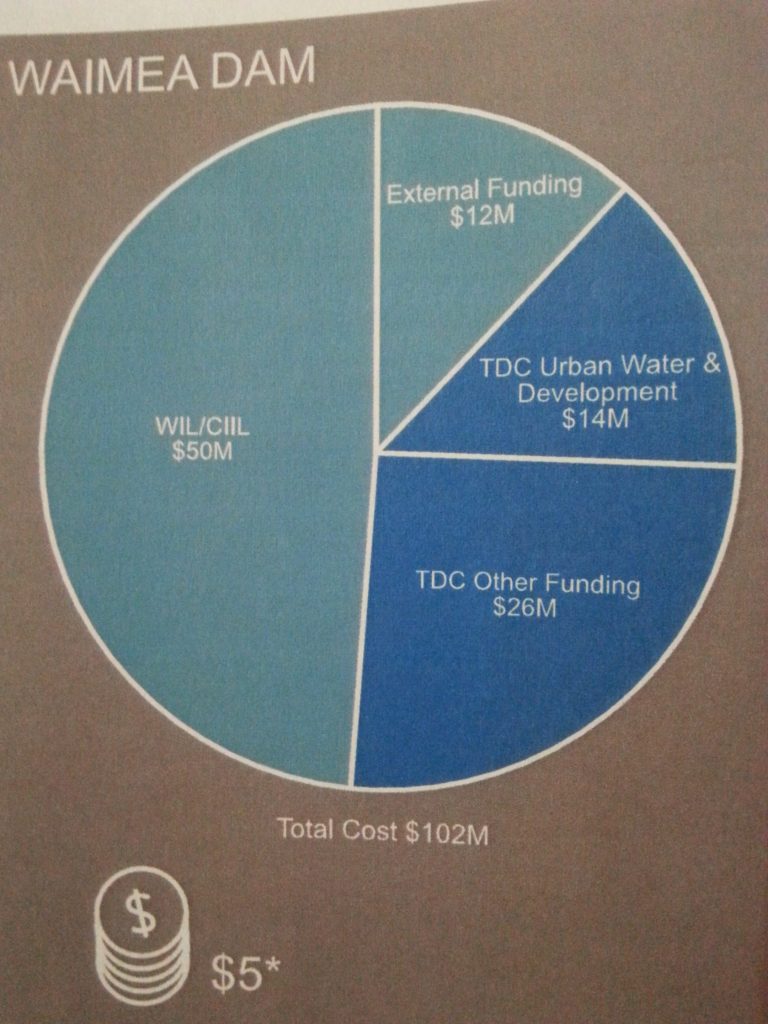
Waimea dam funding pie chart

The TDC staff pie chart is slightly more reflective of the current funding model, although, it also neglects to shade the $35million ratepayer underwrite of the CIIL loan in at the very least a hatched colour.

Let us return for a moment to the “lies” told by dam advocates such as Mayor Kempthorne and senior council staff. This old, often repeated, chestnut is one of my favourite:

Environment and planning manager Dennis Bush-King said “In the worst-case scenario, when there are cease-take directions, Tasman will face its own ‘Cape Town’ situation and people will collect water from tankers.“

Surely this is a fact? Well, it is certainly a possible outcome … if the Council elects NOT to build the dam … AND there is a serious drought … Ohh and a change of council policy (something they neglect to mention – economical with the truth).  The current agenda mentions on at least two occasions that council policy is:

4.16 For many years, Council has accepted that ‘doing nothing’ is not an option when it comes to addressing the water allocation and water quality issues in the Waimea River catchment.

4.35 As noted above, “doing nothing” is not an option when it comes to addressing water allocation and water quality issues in the Waimea River catchment or for securing the urban water supply against droughts and demands from growth.

And yet we proceed to make media statements that the worst-case scenario if the dam doesn’t go ahead is a do nothing option.

There are many other economical uses of the truth in the agenda, however, it is late and tomorrow will likely be a big day as we vote on the dam. As we are told that a $26 million change in the dam funding model is not worth consulting the ratepayers on (even if it means pushing out $20m worth of budgeted projects) I will just leave you with the question I have asked before:

If this dam is so good why are we constantly “lying” to sell it?

Filed Under: Projects, Your Say Tagged With: Lies, Waimea dam

Shane Jones Challenge To Waimea Irrigators

16/08/2018

Shane Jones

If a person or persons were receiving a helping hand (like a subsidy) you would think they would respond with gratitude. Not so with the members of WIL. They have two responses, one is denial, and the other is to attack anyone that suggests they are receiving a subsidy.

Why do people dare to suggest that WIL are being subsidised in relation to the share of the Waimea dam? It is not just me making this outrageous claim Forest and Bird chief executive Kevin Hague questioned why 16 per cent of the fund’s latest grants – making the project the single largest awarded so far – had gone to what he argued was a taxpayer-funded subsidy for irrigation.

If we go back to the beginning (or at least to the beginning of this term of Council) we are presented with a Waimea Community Dam funding policy that was extractive users (irrigators and Tasman District Council/Nelson City Council community water supplies) would contribute one-third of the capital costs of the environmental flows/public good, 30% of the project costs, i.e. 10% of the project costs. All operating costs were to be met by extractive users. That meant that the Council would not contribute operating costs relating to the environmental flow capacity.

WIL out of funds

Then on the 14th of June 2017 Council was presented with a new funding model because “Waimea Irrigators Limited are at (or near) the limit of their ability to pay.”

“That approach to cost allocation on extractive use has been deemed unaffordable to irrigators especially in light of the increase in estimated operating costs.”

“The JV Working Group is developing an alternative for consideration by all parties that involves the Council covering the full costs of the environmental flows. The Council is also being asked to meet the operating costs on the environmental capacity.”

“The revised allocation of operating costs would see the Council contribute 52% of operating costs and irrigators 48%. This approach would see the Council’s operating cost contribution increase by an estimated $460,000 per annum to $675,000 per annum based on current LTP and dam operating cost estimates.”

Not finished there WIL also required an underwrite of their $25 million CIIL loan so they could get a reduction in interest rates. “the project is ‘in the balance’, unless the Council agrees to go back to the negotiating table with a view to meet the additional costs and providing the credit support being requested of it.”

“The Council’s current strong financial position, in particular it’s lower than budgeted debt level puts it in a position where it can accept the irrigator funding debt being held within the Joint Venture. Debt in the JV or in WIL will be treated as Council debt by credit rating agencies.”

By 19 October 2017 the full extent of the subsidy had become apparent for “the Waimea Community Dam (Dam) project to proceed it is likely that Council would need to agree to the overall funding package and Council’s contribution of $26.8m. WIL have made it clear through the funding negotiations that they are at their potential shareholder affordability limit with this funding model.”

The total estimated cost of the Dam project (excluding incurred project costs) is $75.9 million (m). Under the Dam funding proposal this would be funded on the following basis:

  • $50.22m by extractive users, where a secure water supply is guaranteed.

– Irrigators through (WIL) $37.12m

– Nelson City Council’s (NCC) $3.52m

– Council $9.58m

  • $22.77m by Council for the benefits that would accrue to the environment and community generally. This would be funded through:

– $7m grant from the Government’s Freshwater Improvement Fund (FIF Grant)

– $10m interest free loan from Crown Irrigation Investments Limited (CIIL) (that Council would need to repay),

– $1.48m from Nelson City Council

– $4.29m by Council

  • $2.91m by Council for its share of the additional Dam capacity for future use

“Council would provide credit support of up to $29m for the CIIL $25m loan to the dam company for WIL. The reason for the difference is that from day one, once the loan costs and interest are capitalised, the actual potential maximum liability of the loan would be $29m.”

The “future use” component is the difference between the dam capacity of 7765 hae and the portion that irrigators decided would actually be uneconomic for them service, a total of 850 hae. “Additional capacity in the Dam would be shared on a 50/50 basis between WIL and Council. This results in each partner contributing $2.91m. WIL’s contribution is included as part of their $37.12m contribution as in paragraph 5.1.1 above. Because the use of our additional water capacity has not yet been determined, Council is treating this cost as part of the benefits that relate to the environment and community generally.” It will be serviced from surpluses in Council’s Commercial account.

Not yet finished with the subsidies, there was also the small matter of cost overruns.

There is a $13m contingency allowance for the budgeted dam construction cost of $50m. This provides a high level of confidence (95%) that the dam will be constructed within budget. In relation to project cost overruns, amounts between 0 – $3m would be shared on a 50/50 cost share basis between Council with irrigators, while debt above $3m would fall to Council to fund.

There were also those sneaky costs not shared in the project costs that council would raise a further $2m to $2.7m through a Table loan over 30 years to cover additional project costs to financial close.

How far we have strayed from a water extractor or beneficiary pays model.

Where the principle of user pays and/or direct beneficiaries pay is applied to the Dam project, then the allocation of capital cost relative to the levels of current and future extraction is:

  • $37.13m for irrigators (WIL) – 69.9% of $53.13m capital costs allocated to extractive use
  • $12.5m for Council – 23.5% of $53.13m

If the $22.77m capital cost allocation apportioned to environmental/community benefits was fully funded by the exacerbators/users at the same percentage of their extractive use, then Council’s share would be $5.35m and WIL’s $15.92m.

“The total cost if transferred to landowners/irrigators would make it unaffordable for them. It represents a 43% increase in the proposed capital investment and the associated costs.”

To Recap

  1. The urban water user/ratepayer bought more shares (or hectare equivalents) than we will need in 100 years growth.
  2. The urban water user/ratepayer underwrites the WIL loan from CIIL so they get a cheaper interest rate.
  3. The urban water user/ratepayer picks up significantly more running costs than their share of the allocation because it is too expensive for irrigators.
  4. The urban water user/ratepayer picks up all the cost overrun liability (that won’t happen – yeah, right!) because the irrigators are at their limit.

And this is what the irrigators have to say about their subsidy:

On the Waimea Water Facebook page Horticulture NZ Chair and WIL shareholder Julian Raine “there is no subsidization by ratepayers. Irrigators are paying their fair share. This is a myth naysayers have made up. If irrigators do their own augmentation then the rest of the community will pay double the current cost. It’s not rocket science but clearly lost on some. The Dam is a win win solution”

WIL chairman Murray King on Radio Live speaking about the recent protest outside of council “ Probably half the people there were probably in support of the dam.” If 30 supporters are about the same as 300 demonstrators then yes that is the same math that could be used to say the irrigators are paying their fair share.

After being told for the past two years that WIL were at their limit, any more would be unaffordable for irrigators, two weeks after the announcement of a $26 million budget blowout the mayor announced that the irrigators would meet their share. How do they suddenly now find the capacity to meet supposedly an extra $13 million?

Possibly because an MPI case study reveals that:

The dam would also provide close to full water supply reliability for existing irrigators, representing a $2.9 million (or 20%) increase in average annual earnings.

The extra money that the irrigators could contribute is confirmed by Murray King who said:

without a dam, larger irrigators would look to put in their own storage ponds, “which will mean instead of having a community solution, irrigators and the council will end up competing with one another for water”.

“The cost to irrigators to construct on-farm storage will be more than four times what they are currently contributing to the dam,” he said. “If you add the consenting costs and the opportunity cost of the loss of productive land then the figures are even worse.”

  • Shane Jones
    Image credit – BENN BATHGATE/STUFF

Perhaps this is why Shane Jones challenged the region’s civic and economic leaders to do the “vast majority of the heavy lifting” to cover the funding shortfall before they could expect “expeditious treatment” of the growth fund application.

He would not be specific about how much extra funding needed to come from both groups, but thought the economic stakeholders were “capable of picking up quite a bit of that (deficit)”

It sounds like from a Government perspective that if the irrigators are not prepared to “step up to the plate” then the Waimea Dam project is dead in the water.

If the dam fails to get across the line the MPI study reveals that the 64% overallocation would best be solved by:

Clawback based on irrigation needs would result in lower costs than flat-rate cuts (an 8.5% drop in average catchment profit compared with a 10.4% drop) and a slightly more even distribution of those costs. This is a logical conclusion, consistent with the approach already adopted by many regional councils.

Filed Under: Projects, Your Say Tagged With: Shane Jones, Waimea dam, WIL

Scaremongering Mayor

25/07/2018

scare tactics to sell waimea dam

After the announcement that the Waimea Community Dam has run millions, and millions, over budget before a digger has even put a bucket in the ground Tasman Mayor Richard Kempthorne has gone into over drive with the doom and gloom press releases.

As quoted by Cherie Sivignon in the Nelson Mail the Mayor says:

Water tankers may be needed on the streets of Brightwater during severe droughts if the Waimea dam project is shelved.scare tactics to sell waimea dam

“We’ll be slipping into Third World provisions [in a severe drought],” said Tasman district mayor Richard Kempthorne. “I think, the community doesn’t realise that’s what we have ahead of us without the dam.”

Kempthorne said he expected to be accused of scaremongering but the rules for tougher rationing in dry spells were in place under the no-dam provisions in the Tasman Resource Management Plan (TRMP). The rationing and related restrictions would affect rural and urban water users in the Richmond, Hope, Mapua, Brightwater and Redwood Valley areas including businesses and industry.

Of course, what he doesn’t mention is that if the dam project goes ahead as currently planned, there will likely be no inhabited streets of Brightwater. Already, they have proven that they have no idea what the cost of the dam would be, much less that they have any idea of the potential for overruns. Overruns that the ratepayers of this district are solely responsible for. There is every potential that the proposed $100 million-dollar dam could overrun by another $100 million like the Clyde dam. I suspect that by the time that the extra $30 million plus the potential extra $100 million is added to the rate bill of the residents of Tasman there will be a lot of cheap housing for sale as ratepayers file for bankruptcy.

It is rather ironic that when I argued that new residential builds should be required to put in water tanks like their rural neighbours it was argued that it would be too expensive. On the other hand, we can put up water rates by 1000% to pay for a dam and that is acceptable.

Staff have also been roped in to sell the dam at any expense.

“In the worst-case scenario, when there are cease-take directions, Tasman will face its own ‘Cape Town’ situation and people will collect water from tankers,” Bush-King said.

In the worst-case scenario with the dam going ahead we will face Cape Town like situations where a significant number of people will be living in cardboard boxes and shantytowns as they are forced off the land they currently own – if we are going to talk about “worst-case scenarios.”

Kempthorne agreed such a situation would not be palatable to ratepayers.

“That is why I have taken so seriously trying to bring in the Waimea Community Dam – because of the impacts without it.”

The council had a responsibility to provide a secure urban water supply and would have to look at other options if the dam did not proceed.

However, those other options were “considerably more expensive”, Kempthorne said.

I am pleased he explained why he has pushed this dam through with so many casting votes and spent so much money driving this project against the wishes of more than 80% of the consultation respondents because I had been wondering what his motives were.

However, he does again resort to gross exaggeration by stating that those other options were “considerably more expensive.”

Considerably more expensive than what? A $100 million-dollar dam plus full liability for all overruns? I don’t think so. He has conveniently forgotten to upgrade his figures unless Engineering manager Richard Kirby is going to revise the figures of the alternatives again to bring them back inline with the Mayor’s comments.

Last time Kirby revisited the “plan B” options they were found to be in need of some serious rescoping which increased their price by up to four times the previous budgets. When asked to apply the same scrutiny to the Waimea Community Dam he repeatedly came with the same lowball figures used to generate a P95 in 2015. It was a complete surprise when the quote missed the budget by almost $30 million dollars.

Even the recently inflated costs of a storage pond capable of supplying urban water needs for the immediate future is nowhere near the figures now being talked about for the Waimea Dam. While the initial potential plan B pond will not meet the 100-year projections, that they claimed to be able to meet with the dam, it will avert “Cape Town” like conditions in the near future.

Of course there are many options to avert urban residents begging on the streets for a cup of water including further reductions of the irrigation permits to bring allocation back inline with the new water availability requirements. Another might be to raise the price of water as restrictions are applied to ensure water is not wasted. Fixing leaks in the network is an option that many people are calling for, as are water tanks for urban users.

No solutions are going to be without cost, however, one thing is certain, the extra three million dollars that the Mayor used his casting vote to spend on the Waimea dam this term would have been better spent on a project that was affordable. Not to mention the thousands of dollars a day still being spent on the Waimea Community Dam project at the Mayor’s direction.

Filed Under: Projects, Spending Tagged With: Richard Kempthorne, scaremongering mayor, Waimea Community Dam

P95 Probability or Implausibility

07/07/2018

Waimea Dam P95 guarantee

For the past 18 months or so I have heard a lot about the P95.

What is a P95?
Good question!

Homer Simpson Doh
Waimea Community Dam quote = $120 million

I was told that it was a 95% likelihood that the Waimea dam would be built on or under budget.

Given the current state of press releases coming out of the Tasman Council, I thought it would be timely to delve a little deeper into this magical assurance while we await the next announcement. Incidentally, press releases are the only way anyone gets any information regarding the dam (not as big an exaggeration as you might imagine, councillors are just privileged to receive their copy 15 minutes ahead of the general ratepayer).

Back in January 2016, we read in the Nelson Mail the following:

The dam’s estimated cost rose to $83m last year after costs were revised by the council’s consulting engineers…

The council’s $83m figure is based on a risk factor which assumes there is a 95 per cent probability the dam can be built for that amount of money or less. It’s known as P95.

WCD project manager Nick Patterson said the dam can be built for $73m, including the $6.5m already spent. This was using a P50 risk factor that assumed the dam could be built for that amount of money or less.

There was a lot of confidence around what price the dam could be built for and the level of certainty once we added a few extra million and called it a P95. These confident assertions have continued right up until the press release on July 5 2018.

The Mayor was an early adopter of this confident boast as is recorded in articles such as this Stuff article on September 2017:

Richard Kempthorne said the dam costing was based on a “P95” confidence level, which meant the council could have 95 per cent confidence the dam would be constructed at or below the estimated cost.

“At or below the estimated cost” was the catchphrase that echoed the Council chambers every time anyone questioned the possibility of cost overruns. We have used a P95 to arrive at the budgeted figure.

On the 10th of August 2017 Natasha Berkett is quoted in the Farmers Weekly as saying:

However, there was also a $13 million contingency allowance in the $80m project for further increases.

“We are working to a P95 standard that is where we are 95% certain about the cost of the project.”

Waimea Irrigators Ltd advocates John Palmer and Murray King scoffed at any hint that there would be any budget blowout. The Waimea Water site boasts the following:

Are the cost estimates for the Dam accurate?

A great deal of work has gone into the current cost estimates for the dam construction and project leads are currently undertaking another robust analysis.

The base cost estimate for the Dam construction is $50m. On top of that there is $13.5m included in the project estimate for changes in scope and unexpected cost increases. This raises the level of confidence in the estimate to a very high level – there is only a 5% probability that the costs will exceed the $63.6m budgeted and a 95% probability the project will come in on or below budget. That level of confidence is far higher than the typical estimates you might see in other construction projects (emphasis added)

I hope you are feeling convinced in the level of confidence that we have that the dam will come in on or under budget. That is the completed dam, including construction cost blow-outs. We are 95% certain in our facts.

Just in case you still had a few doubts we put out a Dam Straight fact campaign at the ratepayer’s expense of almost fourteen and half thousand dollars (which I realise is chicken feed compared the ten million, in round figures, lost on the project to date).

To prevent large cost overruns, Council is doing all it can to keep risks to a minimum including:

  • using a p95 level for construction costs, meaning that there is a 95% probability that the project will come in at or under budget;
  • using modern engineering and risk management approaches and external professional advice; and
  • $13.5 million contingency for changes in scope and other unforeseen eventualities.

Can there be any doubt as to the robustness of the budget after we used a P95 level, modern engineering and risk management approaches, external professional advice, and even a whopping $13.5m contingency figure for good measure?

Well, some people thought so. One such person is Paul MacLennan who indicated:

TDC’s own recent admission they have never priced the civil cost of the 87 Hectare Reservoir and sealing of the lake bed to hold the 13.4 million cubic meters of water is appalling and makes the TDC claim $76.9 million at P95 a gross misrepresentation.(emphasis added)

A rather strong assertion. He claimed that “clearing 87 Hectares of steep, sloping, and fractured terrain will cost $30 million plus.”  I tried to follow up on his concerns with staff only to receive repeated replies attesting to the robustness of our P95. A P95 that it seems, from reading between press release lines, was so grossly inadequate that it didn’t even cover the quote, never-mind the inevitable construction overruns.

In his submission, during the Waimea Dam consultation process, Dr. Roland Toder questioned the P95 claim.

A so-called ‘P95’, as mentioned by TDC is misleading. In project management, percentiles are expressed by P followed by the percentile. A P95 estimate of  $82.5million means that the project has a 95% chance of being completed with this or less amount of money. Normally one uses data one has from similar activities (like executed several dams of similar size before). Ideally, if you have a number of similar activities (many dams of similar size) that would be best, because from this data, you need to find the mean (expected value) and the standard deviation (to determine the range of error) for each activity. THEN you can calculate cost and timing estimates for the entire project.(emphasis added)

People from the Water Information Network Inc also protested the validity of the P95 figure sold by WIL and Council staff.

  • Tasman District Council (TDC) ad­mit they have never priced the clearing cost of the 87 hectare reser­voir.
  • With steep, slop­ing and frac­tured ter­rain clearance of the area is likely to cost over $30 mil­lion.
  • Similarly, no costing has been made for the seal­ing of the lake bed to hold 13.4 mil­lion cu­bic me­tres of wa­ter.
  • Removed trees, bushes, shrubs, de­tri­tus, top­soil, and stumps will add up to a me­tre-high pile.
  • This will amount to around one mil­lion cubic metres to shift from the Dam’s foot­print area to a stock­pile area where run-off can be man­aged un­til fi­nal dis­posal.
  • Silting up risks and decommissioning costs have not been taken into account.
  • Suitability of rock fill ‘borrowed’ for the Dam wall has not been accurately assessed. So it may not be suitable.
  • All of this indicates that TDC’s claim of $76.9 mil­lion at p95 (95% ‘accurately’ costed) is a gross mis­rep­re­sen­ta­tion. (emphasis added)

I repeat that when I questioned the validity of these claims I was told that we had sufficiently budgeted all aspects of the dam, and early indications on pricing confirmed the validity of the budget.

When I questioned the age of the original estimate given that all our current contracts are experiencing a premium in a high demand marketplace I was again assured that the estimated budget for the Dam was adequate.

At the councillor 15-minute-advance-notice-of-the-press-release meeting, I asked TDC engineering department head Richard Kirby which aspects of the dam quote were currently running over budget he said he didn’t know. When asked what was the range of budget blowout on the figures that had come in to-date he responded that he didn’t know. When I questioned that they had called an extraordinary briefing and are about to send out a press release announcing that there are significant challenges with the contract price meeting budget and yet you are telling me that you have no idea what the overrun gap is? He confirmed that was correct.

The head of Engineering doesn’t know the figures.picture of a guillotine

The Mayor doesn’t want to know the figures.

I want to know whose head is going to roll for misleading the Council over the 95% certainty of the price for building the Waimea Community Dam. Information that resulted in the Council spending the best part of ten million dollars of ratepayer’s money progressing the project to this point. Whether deliberately misleading councillors or doing so through incompetence someone has to be held accountable.


Filed Under: Projects, Your Say Tagged With: P95, Tasman District Council, Waimea dam

Dam Budget Bombshell

05/07/2018

waimea dam budget bomb

Early indications of huge blowout in the Waimea Dam price call into question the entire dam process to date.

Today, Councillors were called into an extraordinary briefing session ahead of the Community Development Meeting where we were informed of a press release going out within minutes stating that there are “significant challenges” with the early dam pricing to achieve a within budget price.

I asked for an indication of what aspects of the dam they had an indication were running over budget – they could not tell me.

I asked what kind of budget blowout range we are talking. Again, they were unable to tell me.

I stressed that they felt it important enough to call an extraordinary briefing and go out with a press release and yet they are telling me that they have no idea of what kind of early indication budget blow out we are talking about. They confirmed that was the case.

We were told that the press release was to address the fact that there is already information “on the street” about the dam budget being insufficient. This is interesting given the ridiculous conditions that they suggest at the last council meeting be imposed on Councillors wishing to view the dam Term Sheets with our partners. It also supports the Councillor’s decision not to accept personal liability for the leaking of information when this dam is already full of leaks. Leaks that could not have come from Councillors as we are not allowed to know any information at all around the current pricing of the dam.

The fact that staff were unwilling to suggest any kind of price range leaves one to speculate that is so far away from the budgeted figure that there is no likelihood we are going to be able to achieve a dam. If that is the case then there are some serious questions that need to be answered.

Do council staff have the experience to manage a project of this magnitude?

When the current members of the Council table wished to revisit the “plan B” options a revised estimate of each project was produced. Without exception every other option had the budget increased by 2, 3, even 4 times the budgets originally presented to council. It turns out that the projects were not fully scoped and there was an array of reasons why the budgets had to be revised to be accurate in the current market.

I asked for a similar review of the Waimea Community Dam as my own assessment, and the advice that I was receiving from experts in the fields of forestry, earthmoving, and even dam building was that aspects of the budget were seriously deficient. The assurance that I was given by staff on numerous occasions was that we are confident that the pricings were accurate. Various aspects of the project along the way we were told were coming in within the budget range. We have been repeatedly assured by our staff, and by the likes of John Palmer, that this budget was so robust we could be 95% sure it will come in on budget.

Why this is important is because Council has elected to continue spending money on the Dam project based on this advice. I am sure it was this advice that the Mayor relied on when he used his casting vote to increase the dam budget by $3million dollars. It was also on the back of this information that the Council elected to proceed with the early contractor engagement process (ECI) to get a finalized quote for the dam – also costing the Tasman ratepayers a significant amount of money.

If the dam fails to proceed due to excessive budget blowouts I feel somewhat responsible as a Councillor. I have failed in my role as governance to monitor the process adequately before we ended up with a $10million bill for a dam project that was not affordable. However, I have been asking questions for the past 2 years, I just have not been getting all the information to make a better-informed decision.

When the irrigators were telling us that they could not afford their share, and urban water users and ratepayers who already paying some of the highest rates in the country could not afford more than their share, I questioned how we could proceed with the project. I should have insisted more strongly that we revisit the viability of the dam.

When I was repeatedly told that we had sufficient budget for aspects of the dam that were clearly under budgeted I should have insisted on further investigation. When I was told that I could not view Term Sheets or the Schedule of Risk I should have insisted as governance that I have a right to view such crucial information before making decisions around the dam.

Mayor with his head in sand
Mayor takes stand on Dam

Alarm bells should have gone off when the Mayor insisted that he did not want to see Term Sheets or the Schedule of Risk. As someone who reserves the right to vote twice (despite my attempt to remove that right) the Mayor should be extra well informed on significant projects that he is voting on, and yet he does not even want to know how much the early quote indication is over budget (as quoted here). Questions have been raised in the community if he is up to the task and I am struggling to find evidence to suggest that he is. Certainly, Mayor Kempthorne’s current approach of burying his head in the sand at every given opportunity does not suggest he is capable of leading significant projects.

Now that we have been given no indication of how much the budget is looking likely to blow out by we are left in the position of assuming that it is as stated in the press release a “significant challenge.” My next line of questioning is how can we trust any figures that we are presented with in the future. If they manage to get the price within budget (or close to it) I will be wondering what corners have been cut to achieve it? What risks have we taken onboard that will result in huge overrun expenditure that the ratepayer is solely liable for because the irrigators have capped their liability?

If the initial estimate was only marginally overbudget you could imagine that things could be tweaked to bring the quote into alignment with the budget. However, a “significant” (staff wording) gap can only be closed by taking shortcuts or a complete redesign. We only have to look across the boundary at the Stoke Greenmeadows project to see where corner cutting and budget skimping leaves a project

I have to say that I have gone from dam sceptical to thinking that those members of the community who have been calling for a judicial review into the process may indeed be barking up the right tree. Ratepayers have a right to know how 10 million dollars of their money could possibly have been wasted on a project that had no way forward. Land acquisition is still far from a certainty, the initial budget was apparently woefully inadequate, consultation and deliberation was dubious at best, what else is yet to be shaken out of the tree?

Like all other ratepayers, I will eagerly wait for a council press release to find out what is going on with the dam!

Filed Under: Projects, Your Say Tagged With: budget blowout, dam budget, Waimea dam

« Previous Page
Next Page »

Introducing Dean

Dean McNamara Husband, father, and a fourth generation local from rural Tasman. No longer acting as your voice on the Tasman District Council (TDC). More about me.

Email Newsletter

Sign up to be informed of important news and upcoming events

Make your voice count

Testimonials

Fantastic Speech

It was great to have your involvement in the dawn blessing of the Mapua Sculpture at the beginning of March. Thank you for the fantastic speech which encapsulated the essence of what the Sculpture Project is all about.

Janet Taylor
Ruby Coast Initiative Trust

You Rock

[Thankyou] for standing up for democracy & the people you represent. In the words of a younger generation “You Rock”!

Beth McCarthy
Takaka

keep sticking it to them

What a great pity there aren’t more councilors like yourself, who stand for council on behalf of the voters, and who remain steadfast in their commitment to being voter representatives and not council mouthpieces

Gary Thorpe
Read more testimonials
  • Testimonial Submission Form

Councillor McNamara: As Reported In The News

  • Latest News
    • Yet Another Unbudgeted Spend
    • Dam Tax Bites Little Guys
    • Freedom Camping Waste
    • No Support For Dam Report
    • Developing Within Boxes
    • Grandstand Funding Folly
    • Population Projections
    • Recycling Lunacy
    • Another Dam Blow Out
    • Councillors Not Qualified Directors
    • Mapua Boat Ramp
    • Pokies Sinking Lid Policy
    • No More Mayoral Casting Vote
    • Votes By Ward
    • Returning as Councillor
  • News From Last Term
    • Signing Off
    • Waste (of) money
    • Port Tarakohe
    • Free Charging Not Free
    • Re Election Candidates
    • NZTA Priorities
    • Mapua Upgrade Begins
    • Another vote Uturn
    • Traffic Woes Government Nos
    • Consult Fairy Tales
    • Capital Stop-Works
    • Kempthorne Quits
    • 20 million not a significant change
    • Over paid Councillor
    • Dam Train Wreck
    • Death Vote For Dam
    • Dam Scarce Water
    • Barbershop Gossip
    • Dam budget blowout
    • Dam Secrets
    • Wakefield Water Supply
    • Kempthorne Casting Votes
    • Mapua Gateway Sculpture
    • Mayor Spends Up Again
    • Mayor has a talk
    • Alleged Propaganda
    • Dam Affodability Questioned
    • Dam Funding Questions
    • Dam Questions
    • Storm Water Priorities
    • Knitting up a storm
    • Old guard take on new committee roles at Tasman District Council

Archives

Share the joy

Why Vote McNamara?

I am MOTIVATED.
I have business EXPERIENCE.
I am fiscally FRUGAL (some say tight!).
I am a born and bred LOCAL - here to stay
I am CONTACTABLE - reach me through this website.
I know together WE CAN DO BETTER.

Tags

3 waters Campground casting vote cost of the dam council councillor role dam overruns Dean McNamara Debt decisions Dr Mike Joy Easter Trading Election fine print free lunch Funding inconsistencies lie Lies Mandates McKee Memorial Reserve performance Pigeon Valley Fire rate affordability Rate increase rates Richmond risks rules Shane Jones spending stormwater strategic misrepresentation Tasman Tasman council elections Tasman District Council tdc TDC propaganda vote Waimea Community Dam Waimea dam waimea irrigators water water bylaw WIL

Copyright © 2026 · TDCME.nz · Powered by Nz Marketing Systems · Log in

This website is authorized by Dean McNamara 22a Edward Street Wakefield